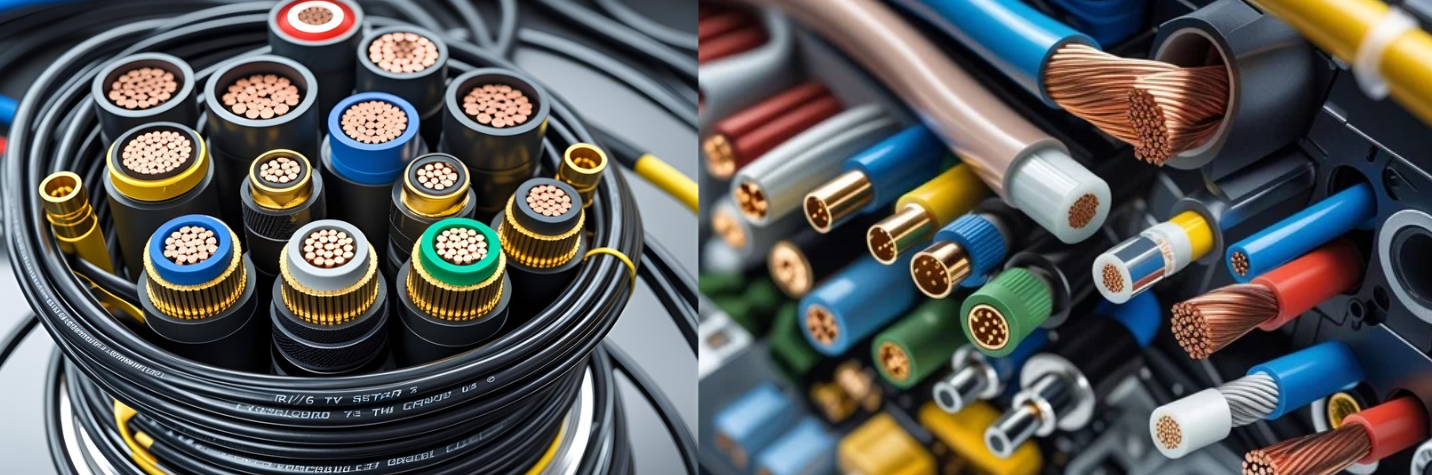
Coaxial cables are an essential infrastructure element, especially in systems where image and data transmission are critical. RG6/U6 cable is one of the most preferred models in this group. They are used in a wide range of applications, from television systems and CCTV infrastructures to satellite connections and broadband internet solutions.
So, what exactly are RG6/U6 cables? What types are available, and in which applications are they most effective? We've examined them in detail.
What is RG6/U6?
RG6 is short for "Radio Guide" and is a type of coaxial cable with an impedance of 75 ohms. The "U" stands for "Universal," meaning general use, and the "6" indicates the cable series. RG6 cables are thicker than models like RG59 and can transmit data over longer distances with less signal loss.
Basic Structure:
-
Inner Conductor (Copper or Steel): It is the center conductor that carries the signal.
-
Dielectric Insulation: It is the insulating layer around the conductor.
-
Foil and Braid Shielding: Blocks electromagnetic interference (EMI).
-
Outer Sheath (PVC, PE, LSZH): Provides mechanical protection and resistance to environmental effects.
RG6/U6 Cable Types
RG6 cables have different outer insulation and shielding structures depending on their intended use. Here are the most common RG6/U6 types:
1. RG6/U6 PVC Cable
✔ Suitable for indoor use.
✔ It has an easily bendable structure.
✔ It is low cost.
Areas of Use:
→ TV systems (SMATV)
→ CCTV camera systems
→ UHF/VHF signal distribution
2. RG6/U6 PE Cable (Outdoor)
✔ Resistant to UV and moisture in outdoor environments.
✔ It has a harder outer sheath structure.
✔ Can also be used in underground applications.
Areas of Use:
→ Outdoor security camera connections
→ Satellite systems
→ Outdoor antenna installations
3. RG6/U6 LSZH (Low Smoke Zero Halogen)
✔ Produces minimum smoke and toxic gas in case of fire.
✔ It is preferred in buildings with high human density.
✔ Provides high security standards.
Areas of Use:
→ Hospitals
→ Schools
→ Shopping malls, hotels and office buildings
4. RG6/U6 CCS (Copper Clad Steel Conductor)
✔ Economical, ideal for short distances.
✔ It has lower resistance to magnetic fields.
✔ Used in low-budget projects in satellite systems and CCTV.
5. RG6/U6 BC (Pure Copper Conductor)
✔ Provides high conductivity and low signal loss.
✔ Preferred in professional systems.
✔ More expensive, but has high long-distance performance.
Where is RG6/U6 Cable Used?
🔹 CCTV Camera Systems:
Used to connect coaxial cameras to DVR systems. Preserves signal quality over longer distances compared to RG59.
🔹 Satellite (SMATV/IPTV) Systems:
Used to carry signals from satellite dishes to a central distribution system. RG6 is ideal for HD broadcasts.
🔹 Devices that Power Wireless Networks (not like POC/PoE, though)
In some analog camera systems, video and power can be carried over the same cable.
🔹 TV Systems (UHF/VHF):
It is used in central antenna systems to transmit images to all indoor TV points.
🔹 Antenna Systems and RF Applications:
It is preferred in RF applications such as FM/AM radio antennas and GSM repeater systems.
Things to Consider When Choosing RG6/U6 Cables
✔ Distance: Pure copper RG6 should be preferred to reduce signal loss over long distances.
✔ Environmental Conditions: PE insulated models should be used for outdoor use; LSZH insulated models should be used for areas at risk of fire.
✔ Signal Type: The shielding structure should be selected according to the needs of the digital or analog system.
✔ Interference Condition: Double shielded (foil + braid) cables provide better performance in intense electromagnetic fields.
Result: Correct Cable, Uninterrupted Transmission
RG6/U6 cables have proven their reliability over the years, particularly in CCTV and satellite systems. However, choosing the wrong type can lead to interference, signal loss, and system errors. Therefore, selecting the appropriate RG6/U6 type for your application is critical to the success of your installation.
If you are planning a professional infrastructure in your facility, not only the right device but also the correct cabling is as important as the devices themselves on the road to success.