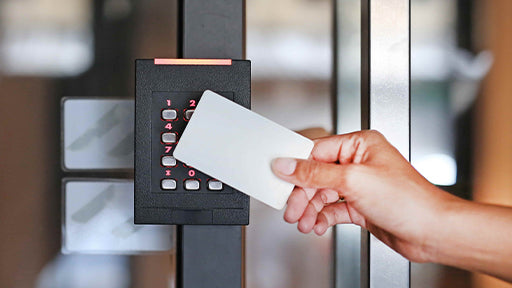
Card access systems, which have become a part of daily life, offer many advantages, from security to time savings. But did you know that the cards used in these systems are different from each other?
Cards don't just open doors; they're also used for functions like identification, time control, visitor tracking, and turnstile management. In this article, we take a detailed look at the card technologies used in card access systems .
🎫 What is a Card Access System?
Card access systems are electronic access control systems that allow users to enter authorized areas by showing their defined cards to the reader.
The most important factor that defines a user's identity is the card type. The technology within the card directly affects how the system operates.
🔍 What are Card Technologies?
The main card types used in card systems are:
1. Magnetic Stripe Cards (Magstripe)
🔹 There is a black magnetic stripe on the back of the card.
🔹 Information is written magnetically on this strip.
🔹 It is frequently seen in ATM and hotel cards.
Advantages:
-
It is cheap
-
Compatible with legacy systems
Disadvantages:
-
Easy to copy
-
It wears out quickly because it is contact.
-
Inadequate in areas requiring high security
Area of Use:
Old building systems, hotel room doors
2. Proximity Cards (125 kHz)
🔹 It is a contactless card type
🔹 It can be read from a short distance (3-5 cm) with the help of the antenna inside.
🔹 Contains only ID (serial number), writing is not possible
Advantages:
-
Economical and durable
-
Contactless ease of use
Disadvantages:
-
There is no encryption
-
The risk of copying is high
-
Tracking and logging capabilities are limited
Area of Use:
Apartments, offices, parking systems
3. Mifare Cards (13.56 MHz – Smart Cards)
🔹 High frequency, contactless and encrypted cards
🔹 Can store data between 1 KB and 4 KB
🔹 User information, subscription, balance, etc. can be written into the card
Advantages:
-
Strong security
-
Advanced application support (Time control, cafeteria, parking, etc.)
-
Long-lasting and durable
Disadvantages:
-
Slightly more expensive than prox cards
-
Compatibility check with readers is required
Area of Use:
Corporate buildings, plazas, campuses, subway systems
4. Desfire Cards
🔹 It is the advanced version of Mifare cards
🔹 Offers multi-layer encryption and higher memory
🔹 Multiple applications can be run on each card
Advantages:
-
It is one of the highest security card systems
-
Complies with ISO/IEC 14443-A standard
-
It combines systems such as transportation, building access, and POS on the same card.
Disadvantages:
-
The price is high
-
Only works on advanced systems
Area of Use:
Banks, universities, integrated transportation systems, hospitals
5. Smart Card (Chip Cards – Contact)
🔹 There is a microchip visible on the card
🔹 Works with physical contact to the card reader
🔹 Used in credit cards and ID cards
Advantages:
-
Data encryption and digital signature support
-
High transaction security
Disadvantages:
-
Contact use is slower
-
Risk of abrasion by physical contact
Area of Use:
e-Government cards, secure login systems
6. Mobile Card and Virtual Cards (NFC / BLE)
🔹 Transfer is made via mobile phone instead of physical card
🔹 NFC or Bluetooth (BLE) technology is used
🔹 Authorization is provided via mobile application
Advantages:
-
Eliminates the need to carry cards
-
Time and cost advantage
-
Remote authorization option
Disadvantages:
-
Device compatibility required
-
Mobile system integration may be required
Area of Use:
Smart offices, hotels, coworking spaces, buildings with mobile access support
🧠 Which Card Should I Choose?
| Need / Security | Recommended Card |
|---|---|
| Simple transition – economical solution | Proximity Card |
| Medium level security and logging | Mifare Card |
| Advanced security and multiple systems | Desfire Card |
| High security + digital signature | Smart Card |
| Those who want to use without a card | Mobile NFC / BLE |
📌 Conclusion: Card Selection is the Heart of the Access System
The card technology used in access control systems directly impacts the system's security level, cost, and ease of use . Choosing the right card determines the system's reliability and longevity.
Don't forget:
“The more secure the door lock, the more important the technology of the card.”