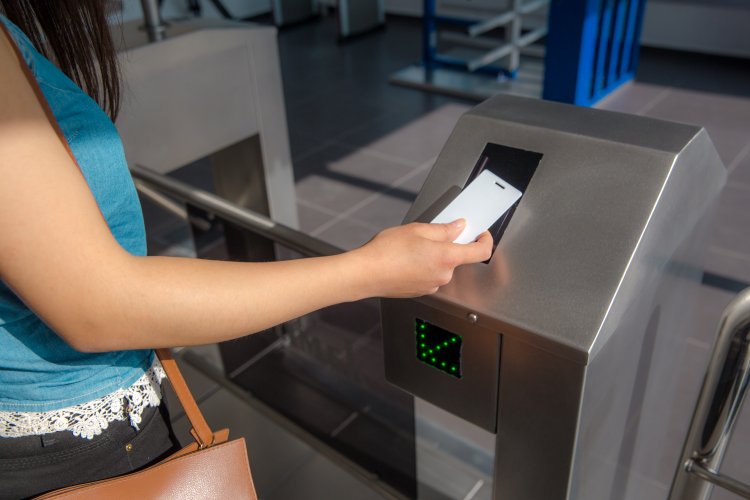
When you entered the door, you scanned your card, the turnstile rotated, and you were let in. This process, so commonplace today, is actually the foundation of modern security and access control. So, what's behind these systems? How do card access systems work, and in what areas are they used?
Let's explore together!
📌 What is a Card Access Control System?
Card access systems are security systems that provide identity verification and authorization at physical access points such as doors, turnstiles, and barriers through cards issued specifically for individuals.
The system determines who can enter which gate, on which day and at which time. This increases security and records entry and exit movements.
🔧 How Does the System Work?
-
The user shows his card to the reader
-
The reader sends card information to the control panel
-
The panel checks the card's access authorization
-
If there is authorization, the door/turnstile is opened and passage is provided.
-
Transition information is processed into the system as a log.
🎫 Card Types Used
| Card Type | Features |
|---|---|
| Proximity Card | Contactless, 125 kHz, includes ID number |
| Mifare Card | 13.56 MHz, encrypted and writable |
| Desfire Card | Preferred in high security, multi-application systems |
| Magnetic Tape | Contact is visible in hotel systems |
| Mobile Card (NFC) | Provides access via smartphone |
🛠️ System Components
-
Card Reader: Mounted on the door, turnstile or barrier
-
Control Panel: Makes authorization decisions
-
Cards: Identify the user identity
-
Software: Manages migrations, provides reports
-
Turnstile / Door Lock: Controls physical passage
-
Power Supply: Ensures uninterrupted operation of the system.
🧩 Where are Card Access Systems Used?
-
🏢 In offices and plazas (employee control, shift management)
-
🏫 In schools (student-parent tracking)
-
🏭 In factories (work safety zones)
-
🏢 In Sites & Residences (elevator floor authorization, parking lot access)
-
🏥 In hospitals (staff / patient entry and exit)
-
🏛️ In public institutions (visitor management)
✅ Advantages of Card Access Systems
-
Provides security: Prevents entry by unauthorized persons
-
Provides tracking: Knowing who is where and when
-
Authorization is flexible: Access can be granted based on hour, day, or area.
-
Easy reporting: All historical transactions can be tracked
-
Can be integrated with time control: Can be combined with PDKS systems
⚠️ Things to Pay Attention to
-
Cards must be backed up and user definitions must be kept up to date.
-
Turnstiles or doors must have an automatic opening function in case of emergency.
-
Within the scope of KVKK, transit information is considered personal data – notification is required.
-
System backup and data security should not be neglected.
🏆 Popular System Brands
| Brand | Featured Feature |
|---|---|
| ZKTeco | Biometric + card system integration |
| HID Global | Highly secure card infrastructure |
| Paradox / Kantech | Infrastructure suitable for large-scale projects |
| Nedap | Can be integrated with vehicle access solutions |
| Mikrosan, Tansa | Domestic production, economical solutions |
📝 Result: Who Entered and When Did They Leave? It's Now Clear
Card access systems have become indispensable tools not only for security but also for streamlining, monitoring, and management . From institutional buildings to residential spaces, these systems are the most practical and secure way to prevent uncontrolled access.
Don't forget:
“Security begins not with locking the door, but with managing the passage.”