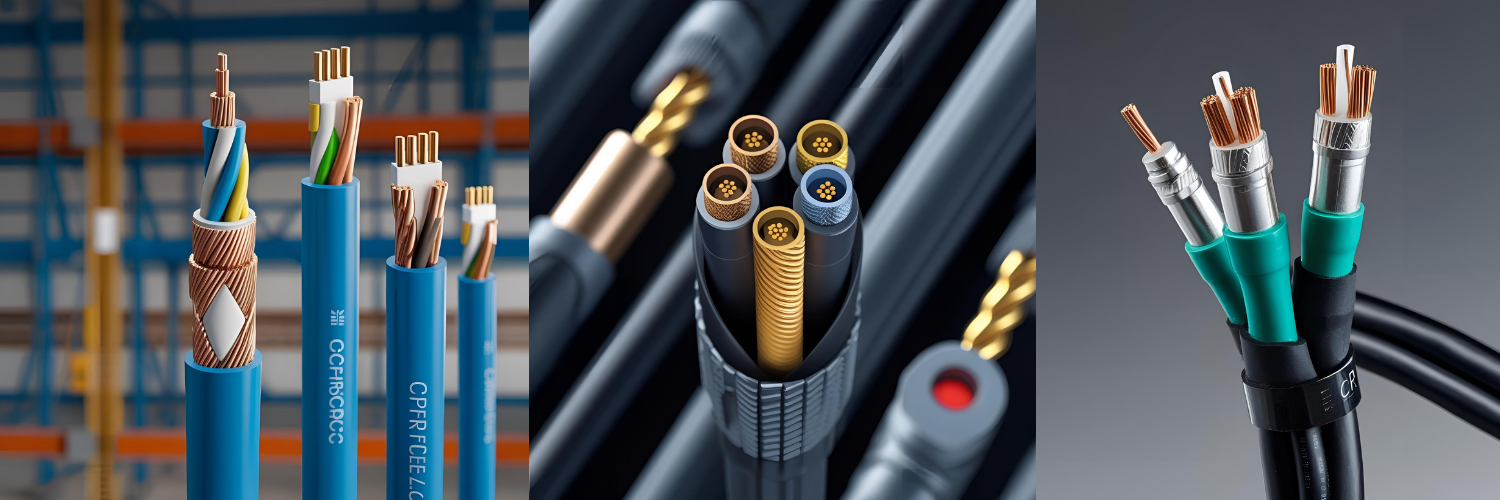
Safety in electrical and data cables is directly related not only to performance but also to fire behavior . To this end, the European Union has established a standardization framework for building materials and introduced a special classification for cables under the Construction Products Regulation (CPR) .
This classification determines the fire response performance of cables and plays a vital role in choosing the right cable, especially in public buildings, hotels, shopping malls, hospitals and offices.
What is CPR?
CPR (EU 305/2011) is a regulation enacted by the European Union in 2017 that classifies building materials based on criteria such as fire safety, environmental suitability, and performance . According to this regulation, cables are also considered building materials .
Cables suitable for CPR are tested according to the EN 50575 standard and divided into certain classes according to their performance.
CPR Cable Classification Table
Cables are classified from A to F according to their reaction to fire as follows:
| Class | Fire Resistance | Explanation |
|---|---|---|
| Aca | Very high | Non-flammable, maximum fire resistance (rarely used) |
| B1ca | Very high | It is very difficult to catch fire and emits very little heat. |
| B2ca | High | Difficult to ignite, gives off limited heat |
| Cca | Medium-High | Controlled flame spread, low heat release |
| Dca | Middle | Resistance to standard flame propagation |
| Eca | Low | Minimum fire performance (entry level) |
| Fca | Uncertain | Untested or failed product |
🔸 Note: The "ca" suffix represents "cable".
Additional Performance Criteria
In addition to some CPR classes, 3 other critical parameters are evaluated:
| Criterion | Explanation |
|---|---|
| s1, s2, s3 | Smoke Production (Smoke Density) |
s1 : Very little smoke |
|
s2 : Moderate smoke |
|
s3 : Dense smoke (unclear) |
|
| d0, d1, d2 | Flaming Droplets |
d0 : No drops |
|
d1 : Limited drop |
|
d2 : Dense drop |
|
| a1, a2, a3 | Acidity (Acidic Gas Emission) |
a1 : Low toxic gas |
|
a2 : Moderate gas |
|
a3 : Uncertain/dense gas |
📌 An example statement:
Cca-s1,d0,a1 → Moderate fire resistance, little smoke, no drips, low toxic gas generation.
Where is CPR Class Cable Selection Mandatory?
The mandatory CPR class is determined by the building's intended use, occupancy and evacuation time:
| Field Type | Minimum Recommended CPR Class |
|---|---|
| Residential (low density) | Eca |
| Office, workplace | Dca |
| Shopping mall, cinema | Cca-s1,d1,a1 |
| Hospital, school, hotel | B2ca-s1,d0,a1 |
| Critical structures such as subways, tunnels, airports | B2ca and above |
Are CPR Classes and LSZH the Same Thing?
No.
🔸 LSZH (Low Smoke Zero Halogen) cables produce less smoke and toxic gases in case of fire.
🔸 However, CPR measures the fire response of the entire cable, not just the insulation material .
Therefore, a cable may be LSZH but have a lower CPR rating . The most accurate assessment is made with a CPR certificate.
Things to Consider When Purchasing CPR Certified Cables
✅ CE Marking and DoP (Declaration of Performance): Must be presented with the product
✅ CPR Class Should Be Written on the Packaging
✅ Fire tests must be performed by accredited laboratories.
✅ Certification should be taken into account, not the manufacturer's declaration.
Conclusion: CPR Class is a Necessity, Not a Luxury
In modern buildings , life safety and evacuation times are directly dependent on the fire response of the cables used. The CPR regulation has become a fundamental criterion not only for European projects but also for projects in Turkey.
What makes a cable “good” today is not just its signal performance; it also provides safety in case of fire.
When choosing your cable , be sure to look not only at the price but also at the CPR class.